For decades, sports sponsorship has been evaluated through a familiar lens: impressions, reach, and logo visibility. Brands invest millions to place their marks inside stadiums, believing that scale alone signals success. But visibility does not equal influence. A logo on a scoreboard may be seen, but it is rarely felt. And in an era where fan attention is fragmented and expectations are higher than ever, being seen is no longer enough to matter.
This is the growing tension at the heart of modern sponsorship. Brands continue to spend at record levels across leagues like the NFL and NBA, yet many still struggle to articulate what that investment is truly delivering beyond exposure. The gap between presence and performance is widening.
According to Forrester research, 76 percent of U.S. marketers who invested in sports sponsorship in 2024 said they struggle to calculate ROI. That statistic is more than a data point. It is a signal that the traditional playbook is no longer sufficient.
Impression-based metrics were built for a different era of media. They reward scale, not connection. They capture what fans see, but not what they believe, feel, or do as a result. And those are the dimensions that ultimately drive business outcomes.
Consider a brand like State Farm. Its long-standing presence across sports is not just about logo placement; it is reinforced through storytelling, personality, and cultural relevance – often anchored by recognizable figures and consistent messaging. The impact is not just awareness, but affinity. That distinction is where real ROI lives.
For brands to win in sports today they need to shift their mindset from exposure to resonance. They need to ask a different set of questions. Not “How many people saw us?” but “How did we show up in the life of a fan?”
This is where sponsorship begins to behave less like media and more like brand building. It becomes participatory, contextual, and human. And importantly, it becomes measurable in ways that matter.
Marketers need more than impression metrics, which is why BaM Sports developed the Magnetic Score™ sponsorship diagnostic tool. The Magnetic Score measures four brand dimensions across the sponsorship fanbase: recognition, understanding, trust, and consideration.
Each of these dimensions reflects a different layer of brand connection. Recognition answers whether fans know you are there. Understanding reveals whether they know what you stand for. Trust measures credibility and emotional confidence. Consideration determines whether fans would actually choose your brand.
Together, these dimensions create a far more complete picture of sponsorship performance. They move measurement from passive exposure to active relationship.
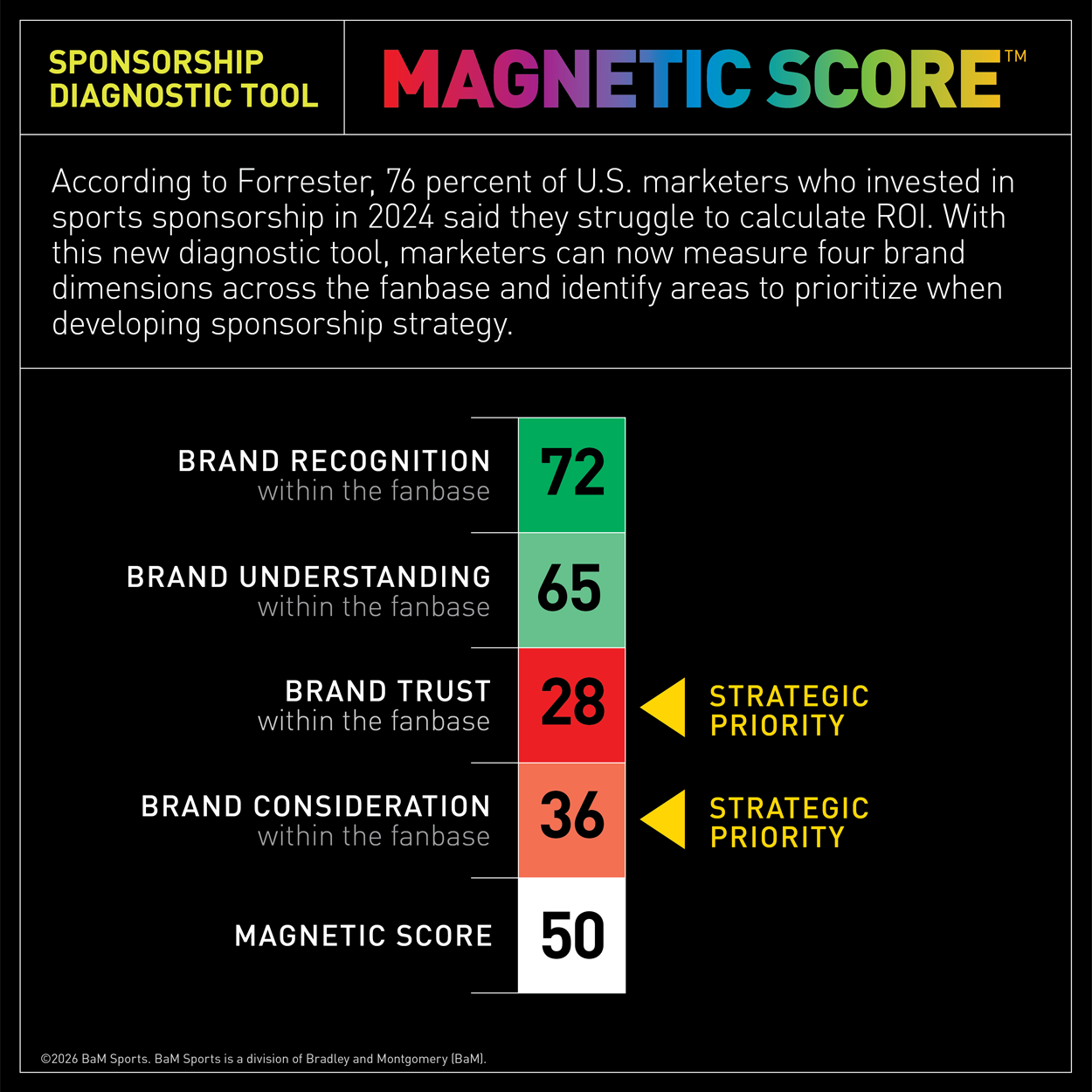
The real power of the Magnetic Score is not just in measurement, but in diagnosis. It reveals where a brand is strong and where it is falling short, allowing marketers to take targeted action.
When recognition is low in the stadium environment, brands need to rethink how they break through the noise. This may mean investing in more dynamic, fan-first experiences rather than static placements, or creating moments that demand attention rather than simply occupying space.
When understanding is low, the issue is often clarity of message. Brands should focus on storytelling and programs that connect their purpose to the passion of the sport. A financial brand like Huntington Bank, for example, could establish a program that helps low-income families send their children to sports camps. Rather than simply appearing on stadium signage, the brand would be actively investing in the future of youth sports and making participation more accessible for families. That kind of initiative gives fans a clearer understanding of what the brand stands for and how it supports the community beyond game day.
When trust is low, authenticity becomes critical. Fans are quick to detect when a brand feels like an outsider. Partnerships, community involvement, and consistency over time help build credibility. Bud Light, through its long-standing presence in sports culture and its ability to tap into shared fan rituals, demonstrates how sustained engagement can strengthen trust when paired with culturally relevant moments.
When consideration is low, fans may like the brand but aren’t choosing it. Brands must create clearer pathways for fans to choose them, whether through exclusive offers, integrated experiences, or utility that extends beyond the game itself.
At BaM Sports, we believe the future of sponsorship measurement is not about counting impressions but understanding impact. The Magnetic Score provides a framework for brands to evaluate how they are truly showing up in the lives of fans and where they need to evolve. Because in today’s landscape, the brands that win are not the ones that are seen the most. They are the ones that are felt the strongest.